

Introduction
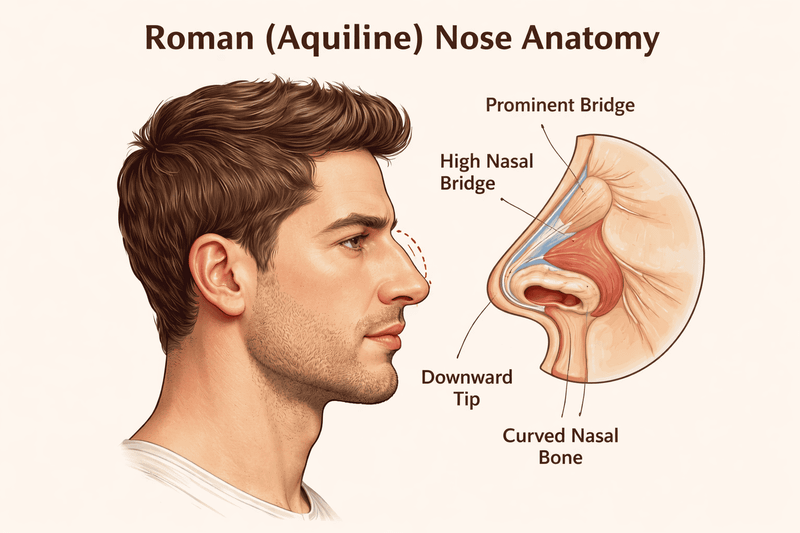
A roman nose is a distinctive facial feature recognized mainly by its prominent bridge and slightly curved or convex profile. Dictionaries commonly describe it as a nose with a high or prominent upper bridge. The term often overlaps with “aquiline nose,” although people may use the two descriptions somewhat differently.
The shape has attracted attention throughout art, literature, history, and modern discussions of facial features. However, a roman nose is simply a natural variation in human anatomy. It does not determine a person’s personality, intelligence, character, or background. Modern sources emphasize that this nose shape appears among people from many different populations.
What Is a Roman Nose?
A roman nose generally has a noticeable bridge that rises higher than the surrounding facial profile. From the side, the bridge can appear straight with a subtle outward curve or have a more visible dorsal prominence.
The exact appearance varies from person to person. Some examples look relatively gentle, while others have a more pronounced curve. Facial proportions also affect how prominent the bridge appears. Medical literature notes that the relationship between the bridge, forehead, and other facial structures can influence whether a profile appears to have a nasal hump.
The term “aquiline” provides another useful description. It comes from Latin and refers to an eagle-like appearance, reflecting the curved shape associated with an eagle’s beak.
Key Features of a Roman Nose
Several characteristics commonly appear in this nose shape:
Prominent Bridge
The most recognizable feature is a raised or clearly defined nasal bridge. This gives the profile a strong appearance compared with a flatter bridge.
Curved or Convex Profile
The bridge may curve outward gently. In some people, the curve creates a visible bump, while in others the transition remains subtle.
Strong Side Profile
Because the bridge stands out, this feature can become especially noticeable when viewing the face from the side.
Natural Variation
Not every roman nose looks identical. Nasal shape depends on the underlying bones, cartilage, soft tissue, and overall facial proportions. Genetics and normal human variation contribute to these differences.
Roman Nose vs. Aquiline Nose
The terms roman nose and aquiline nose are frequently treated as synonyms. Both describe a prominent nasal bridge and a profile that can have a curved appearance.
Still, descriptions can vary between sources. Some writers use “aquiline” for a stronger eagle-like curve, while “roman nose” may describe a broader range of prominent bridges.
There is no single universal measurement that determines whether someone has one. Facial features exist along a spectrum rather than in perfectly separated categories.
Why Is It Called a Roman Nose?
The name has a long history. Historical writing connected the feature with Roman portraits and artistic representations. An old nineteenth-century text, Notes on Noses, even described the Roman and aquiline nose as related forms. However, its claims about personality and national character reflect historical beliefs rather than modern science.
The association with ancient Rome also became influential in art and literature. Prominent noses appeared in many historical portraits, helping create the familiar cultural image associated with the term.
It is important to separate this history from modern biology. Having a particular nose shape does not prove Roman ancestry or any specific ethnic background. Research and modern references recognize this feature across geographically diverse populations.
Roman Nose in Art and Culture
Facial features have carried different meanings in different periods. Artists have sometimes used a prominent bridge to create a strong, distinctive, or authoritative profile.
The feature also appears in descriptions of historical figures and fictional characters. Cleopatra, for example, has often been depicted with a prominent aquiline profile. Historical discussions of her appearance show how strongly the shape of the nose has influenced ideas about beauty and identity.
However, cultural preferences change. A facial feature praised in one period may receive a completely different reaction in another. There is no universal standard that makes one natural nose shape better than another.
Does a Roman Nose Affect Breathing?
Usually, the appearance of a prominent bridge by itself does not mean that a person has a breathing problem. A nose can have a noticeable external shape while still functioning normally.
Breathing concerns can involve internal structures such as the nasal septum and airway. Therefore, appearance alone cannot determine nasal function.
If someone experiences persistent difficulty breathing through the nose, congestion, pain, or changes following an injury, a qualified healthcare professional can assess the underlying cause.
Roman Nose and Rhinoplasty
Some people consider rhinoplasty because they want to change the appearance or function of their nose. Modern rhinoplasty can address different structural concerns, including prominent dorsal features. Historical medical literature documents procedures specifically developed to correct exaggerated Roman or aquiline nasal contours.
However, surgery is a major personal decision and should never be treated as something a person needs simply because their features differ from a beauty trend. Facial appearance naturally varies, and there is no medically necessary reason to change a normal nose solely because it has a particular shape.
For anyone considering a medical procedure, an appropriately qualified healthcare professional should explain potential benefits, limitations, risks, and alternatives.
Common Myths About the Roman Nose
Myth 1: It Shows Personality
Historical sources sometimes connected nose shapes with traits such as strength or determination. There is no scientific basis for using nose shape to predict personality.
Myth 2: It Belongs to One Ethnic Group
A roman nose can occur among people from many parts of the world. It cannot reliably identify someone’s ethnicity or ancestry.
Myth 3: Every Roman Nose Has a Large Hump
Not necessarily. The bridge can range from subtly curved to noticeably prominent. Natural facial features exist across a broad spectrum.
FAQs
Is a roman nose the same as an aquiline nose?
They are often used interchangeably. Both terms generally describe a prominent bridge with a curved or convex profile.
Is a roman nose rare?
No. Prominent and curved nasal profiles occur naturally in many populations around the world.
Can a roman nose affect breathing?
The external appearance alone does not determine breathing ability. Internal nasal structures play an important role in airflow.
Why is it called a Roman nose?
The term developed through historical associations with Roman facial representations and descriptions of prominent nasal profiles.
Does a roman nose indicate Roman ancestry?
No. A nose shape cannot reliably establish ancestry or ethnicity.
Conclusion
A roman nose is a natural facial variation characterized mainly by a prominent bridge and, in many cases, a gentle outward curve. Its appearance can differ significantly between individuals, making each person’s profile unique. Dictionaries and medical sources describe the feature primarily in anatomical terms rather than as a marker of personality or identity.
Throughout history, artists and writers have attached cultural meanings to prominent noses, but those interpretations reflect changing social ideas rather than scientific facts. Today, the most useful way to understand a roman nose is simply as one of the many normal forms that human facial anatomy can take.










Leave a Reply