

Introduction
The hamsa is one of the most recognizable symbols associated with the Middle East and North Africa. Usually shown as an open hand, sometimes with an eye in the center of the palm, it has appeared in jewelry, artwork, household decorations, and traditional objects for generations. The word comes from a Semitic root connected with the number five, referring to the five fingers of the hand.
Although many people connect the symbol with Islam or Judaism, its story is more complex. The open-hand motif has older roots in the ancient Near East and later developed different meanings among various communities. Today, the hamsa remains both a cultural symbol and a popular design worldwide.
What Is Hamsa?
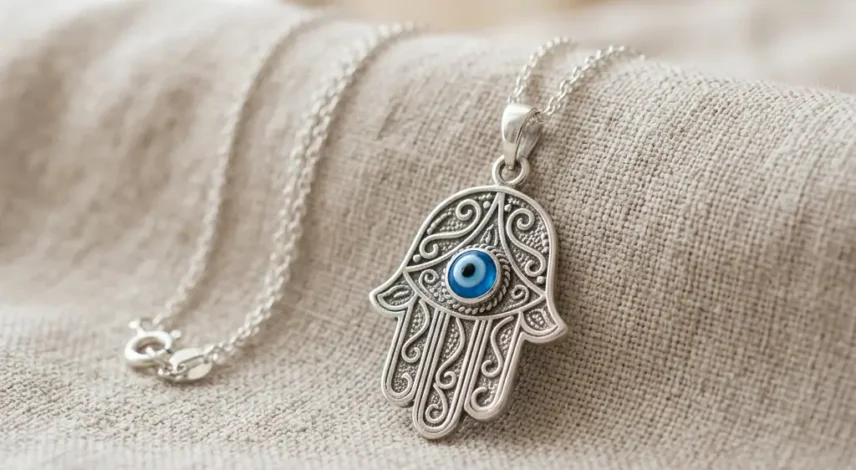
The hamsa is a palm-shaped symbol featuring five fingers. Many designs make the hand symmetrical, with the thumb and little finger extending outward. An eye often appears in the middle of the palm, linking the symbol strongly with the idea of protection from the evil eye.
The term “hamsa” comes from the Arabic word for “five.” A related Hebrew term, “hamesh,” also means five. This simple connection explains why the number five plays an important role in interpretations of the symbol.
You may also see the symbol called the Khamsa, Hand of Fatima, or Hand of Miriam. Different names reflect the traditions and communities that adopted and interpreted it.
The History of Hamsa
The history of the hamsa reaches back far beyond modern religious and decorative use. Archaeological and historical research has identified protective open-hand motifs in the ancient Near East. Some scholars connect later hand symbols with earlier protective traditions, although the exact path from ancient motifs to the modern hamsa remains debated.
The symbol also became important in North African cultures. In particular, traditions associated with ancient Carthage included hand imagery connected with the goddess Tanit. Similar protective motifs continued to appear across different communities over many centuries.
This long history makes it difficult to describe the hamsa as belonging exclusively to one religion or civilization. Instead, it developed through cultural exchange and acquired different meanings in different places.
Hamsa in Islam
In Islamic cultural traditions, the symbol is commonly associated with Fatima al-Zahra, the daughter of the Prophet Muhammad. For this reason, people often call it the “Hand of Fatima.”
The interpretation varies between communities. In some Shi’a traditions, the five fingers can connect with the five members of the Ahl al-Bayt, giving the hand a particular devotional meaning. Other popular interpretations connect the number five with important elements of Islamic practice.
It is important to remember that Muslims do not all view amulets and symbolic objects in the same way. Some religious interpretations reject the use of protective amulets, while the hamsa remains an important cultural symbol in many Muslim societies.
Hamsa in Judaism
Jewish communities have also used the hamsa, particularly among Sephardi and Mizrahi Jewish communities. It is sometimes called the Hand of Miriam, referring to Miriam, the sister of Moses and Aaron.
Jewish interpretations can connect the hand with divine protection. The symbol has appeared in Jewish decorative arts, household objects, jewelry, and manuscripts. Some Jewish interpretations also connect the number five with the five books of the Torah.
Scholar Shalom Sabar describes the development of the hamsa within Jewish and Israeli society as a complicated process involving cultural exchange, adaptation, and changing attitudes toward folk traditions.
The Hamsa and the Evil Eye
One of the strongest associations of the hamsa is protection against the evil eye. The evil eye refers to a longstanding belief that an envious or harmful gaze can bring misfortune.
The eye placed inside the palm reinforces this protective idea. The open hand can appear to signal a barrier against harmful influences, while the eye represents awareness or watchfulness.
However, beliefs about the evil eye differ significantly between cultures and religions. The hamsa should therefore be understood as a cultural and symbolic tradition rather than as something with scientifically proven protective powers.
What Does the Hamsa Symbolize?
Although interpretations vary, several themes appear repeatedly:
Protection
Protection remains the most common meaning. The open hand traditionally represents a barrier against harm and negative influences.
Blessing and Good Fortune
In many modern interpretations, the symbol represents blessings, happiness, luck, and positive wishes.
Strength
An open hand can communicate confidence, strength, and the ability to face difficulties.
Cultural Identity
For many people, the symbol also represents family heritage, regional history, religious tradition, or cultural identity.
Hamsa in Modern Design
Today, the hamsa appears far beyond its traditional settings. Jewelry designers use it for necklaces, bracelets, earrings, and decorative pieces. Artists incorporate it into paintings, prints, textiles, and home décor.
Its recognizable shape makes it especially suitable for modern graphic design. Some contemporary designs use traditional eyes and patterns, while others create minimalist versions with simple outlines.
The symbol’s popularity has also created an important conversation about cultural meaning. When using a traditional symbol as decoration, understanding its background can help people appreciate it respectfully rather than treating it as an unexplained fashion trend.
Why Is Hamsa Still Popular?
The continuing popularity of the hamsa comes partly from its simple but powerful visual form. An open hand is easy to recognize, while the number five gives the design a clear symbolic foundation.
Its cross-cultural history also makes it especially interesting. Jewish, Muslim, Christian, and other communities have encountered or interpreted hand symbols in different ways. Research describes the hamsa as a shared cultural symbol whose meanings have changed over time.
For modern audiences, it can represent protection, heritage, spirituality, or simply appreciation for Middle Eastern and North African art.
Frequently Asked Questions
What does hamsa mean?
Hamsa comes from a word meaning “five,” referring to the five fingers of the hand. The symbol commonly represents protection and is strongly associated with the evil eye.
Is hamsa an Islamic symbol?
It is strongly associated with Islamic cultural traditions and is often called the Hand of Fatima. However, its history predates Islam, and Jewish and other communities have also used the symbol.
What does the eye inside hamsa mean?
The eye is commonly associated with protection against the evil eye. It is a visual reminder of the symbol’s protective purpose.
Why is it called the Hand of Miriam?
Some Jewish traditions call the symbol the Hand of Miriam, connecting it with Miriam, the sister of Moses and Aaron.
Is hamsa still used today?
Yes. People use it in jewelry, artwork, home decoration, and cultural designs around the world.
Conclusion
The hamsa carries a fascinating history shaped by different cultures, regions, and religious traditions. Its open hand and optional central eye have become widely recognized signs of protection, while its five fingers explain the meaning behind its name. Historical research shows that the symbol developed through a long process of cultural exchange rather than belonging exclusively to one modern tradition.
Today, the hamsa remains meaningful because it combines a simple visual design with centuries of cultural history. Whether encountered in Jewish art, Islamic cultural traditions, North African heritage, or contemporary design, it offers a reminder of how symbols can travel across communities and gain new meanings while retaining connections to their past.









Leave a Reply